
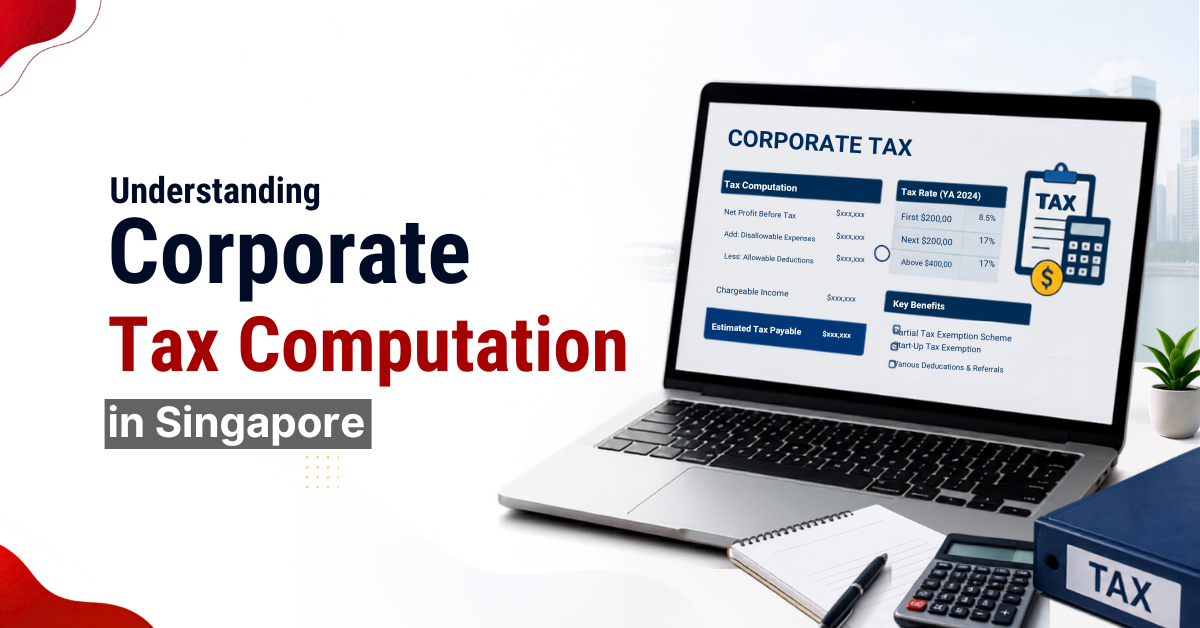
Every company in Singapore that files a corporate income tax return needs to prepare a tax computation. Yet many business owners and even some finance staff assume that the profit shown in their financial statements is the same figure used to calculate tax. It is not.
Corporate tax computation is the process of adjusting accounting profit to arrive at the income that is actually chargeable to tax. According to IRAS, this adjustment is necessary because accounting rules and tax rules do not always treat income and expenses the same way. Some expenses that are perfectly valid in your financial statements are not allowed for tax purposes, while certain reliefs and allowances that reduce tax are not part of your accounting profit at all.
Many people have several questions in mind when they first start learning about corporate tax in Singapore. This blog explains the basics clearly before moving into the details of how a tax computation is actually prepared. Those looking for quick answers to common questions can also refer to the Corporate Tax Training FAQs: Complete Guide.
What Is Corporate Tax Computation?
A corporate tax computation is a schedule that starts with a company’s accounting profit and adjusts it, step by step, to arrive at the amount of income that is taxable under Singapore law.
Companies prepare this schedule because accounting profit is calculated for financial reporting purposes, following accounting standards, while tax computation follows the rules set out by IRAS. These two frameworks serve different goals, so the resulting figures are rarely identical.
The tax computation plays a central role in corporate income tax filing. It forms the basis for the numbers reported in Form C-S or Form C, and it is the document IRAS expects a company to hold as support for those figures. In short, the accounting records show how the business performed, while the tax computation shows how much of that performance is taxed.
Why Corporate Tax Computation Is Important in Singapore
A tax computation is not an optional exercise. It is required before a company can complete Form C-S or Form C, since these forms rely on figures the computation produces.
Beyond meeting a filing requirement, a proper tax computation:
- Helps determine the correct taxable profit for the year, rather than relying on accounting profit alone.
- Supports accurate tax reporting, so the amount declared to IRAS matches what the rules actually require.
- Reduces filing errors that can lead to queries, penalties, or the need to file amendments later.
- Helps businesses maintain proper documentation in case IRAS reviews or audits the company’s tax position.
For finance teams, a well-prepared computation also makes it easier to explain how a company arrived at its tax figures, which is useful both for internal reporting and for any future correspondence with IRAS.
How Corporate Tax Computation Works
At a high level, preparing a tax computation follows a consistent sequence of steps.
Step 1: Start with Accounting Profit The process begins with the net profit shown in the company’s financial statements, prepared according to accounting standards.
Step 2: Identify Tax Adjustments The next step is to review the accounting profit and identify items that are treated differently for tax purposes.
Step 3: Separate Allowable and Non-Allowable Expenses Expenses are sorted into those that can be deducted for tax purposes and those that cannot, since only allowable expenses reduce taxable income.
Step 4: Apply Capital Allowances (where applicable) If the company owns qualifying fixed assets, capital allowances are applied to reflect wear and tear in a way that tax rules recognise.
Step 5: Calculate Chargeable Income Once all adjustments and allowances are applied, the result is the chargeable income, the figure that tax is actually calculated on.
Step 6: Determine Corporate Income Tax Payable Finally, the applicable tax rate is applied to the chargeable income to arrive at the amount of corporate income tax owed.
Understanding the Main Components of a Tax Computation
Accounting Profit
Accounting profit is the net profit or loss reported in a company’s financial statements. It is calculated according to accounting standards and reflects the overall financial performance of the business, including all income and expenses recorded during the year.
Tax Adjustments
Tax adjustments are needed because accounting profit includes items that tax law treats differently. Some expenses recorded in the accounts are not deductible for tax purposes, and some income recognised for accounting purposes may not be taxable in the same way. These adjustments bring the figure in line with what tax law actually permits.
Allowable Expenses
Allowable expenses are business costs that are generally deductible under Singapore tax rules, provided they are incurred wholly and exclusively in producing the company’s income. Common examples include employee salaries, rental of business premises, and other day to day operating costs.
Non-Allowable Expenses
Non-allowable expenses are costs that a company may record in its accounts but cannot deduct for tax purposes. Examples often include private or personal expenses, certain donations, fines, and expenses that are capital in nature. These amounts are added back to accounting profit during the computation.
Capital Allowances
Capital allowances allow companies to claim tax relief on the cost of qualifying fixed assets, such as machinery or equipment, over time. Since depreciation recorded in the accounts is not deductible for tax purposes, capital allowances take its place and directly reduce chargeable income.
Chargeable Income
Chargeable income is the final figure used to calculate how much corporate income tax a company owes. It reflects accounting profit after all tax adjustments, allowable deductions, and capital allowances have been applied.
Simple Example of a Corporate Tax Computation
To see how this works in practice, here is a simplified example. The actual figures used by a real company will vary, but the structure remains the same.
- Accounting Profit: This is the starting point, taken directly from the financial statements.
- Add back non-deductible expenses: Items such as certain donations or private expenses are added back, since they reduced accounting profit but are not allowed for tax.
- Less allowable deductions: Any additional deductions recognised under tax rules but not fully reflected in accounting profit are subtracted.
- Less capital allowances: The capital allowances for qualifying fixed assets are deducted.
- Final chargeable income: What remains after these adjustments is the chargeable income, which is the amount tax is calculated on.
This example is intentionally simple, since the goal is to understand the flow of a computation rather than to work through complex figures. In practice, an actual computation may include several more line items depending on the nature of the business.
Common Mistakes When Preparing a Corporate Tax Computation
Even experienced finance staff can make mistakes when preparing a tax computation Singapore companies are required to file. Common issues include:
- Using accounting profit without tax adjustments. Treating accounting profit as if it were already the taxable figure, without applying any adjustments.
- Incorrect expense classification. Deducting an expense that is not allowable, or failing to add back one that should be.
- Missing capital allowance claims. Overlooking qualifying assets, which results in paying more tax than necessary.
- Incomplete supporting schedules. Not preparing the detailed schedules that explain how each adjustment was calculated.
- Documentation errors. Missing or inconsistent records that make it difficult to support the figures if IRAS asks for clarification.
These mistakes are usually not due to a lack of effort, but a lack of familiarity with how tax rules differ from accounting rules.
Skills Needed to Prepare Corporate Tax Computations
Preparing an accurate computation calls for a mix of technical and practical skills, including:
- Financial statement interpretation, to understand where accounting profit comes from.
- Singapore corporate tax rules, to know which expenses and allowances apply.
- Tax adjustments, to correctly identify what needs to be added back or deducted.
- Documentation, to keep clear records that support every figure used.
- Analytical thinking, to work through each adjustment logically rather than guessing.
- Accuracy and attention to detail, since small errors can affect the final chargeable income.
Who Should Learn Corporate Tax Computation?
Corporate tax computation is a useful skill for a wide range of people, including:
- Accountants, who need to prepare or review computations as part of their work.
- Finance Executives, who handle tax reporting alongside other financial duties.
- Tax Professionals, who work directly with clients on tax filing and planning.
- SME Finance Teams, who often manage tax computations without a dedicated tax department.
- Business Owners, who want to understand how their company’s tax figures are derived.
- Accounting Graduates, who are building the practical skills needed for entry level finance roles.
How Corporate Tax Training Can Help
Reading about tax computation is a good starting point, but applying it correctly takes practice. Structured training helps in several ways:
- Understanding IRAS requirements, so learners know what the rules actually expect rather than relying on assumptions.
- Learning tax computation using practical examples, which makes the process easier to follow than reading regulations alone.
- Applying tax concepts correctly, since guided practice reduces the chance of common mistakes.
- Building confidence in preparing tax computations, which comes from working through real scenarios rather than theory alone.
Learners who want structured guidance and hands-on practice can explore our Corporate Tax Training in Singapore, where tax computation, tax adjustments, allowable expenses, and practical case studies are covered in a structured learning environment.
Conclusion
Corporate tax computation in Singapore is an ongoing responsibility rather than a task that comes up only once a year. It calls for a clear grasp of how accounting profit differs from chargeable income, which expenses qualify as allowable, and how capital allowances factor into the final figure.
A solid understanding of these adjustments helps companies prepare more accurate tax computations and file corporate income tax returns that stay compliant with IRAS requirements. For anyone who handles corporate tax on a regular basis, strengthening this knowledge through structured learning is a practical step toward getting it right consistently, year after year.
Disclaimer:
This article is intended as general guidance on how corporate tax computation works in Singapore and does not constitute tax advice. Companies should refer to current IRAS guidelines or consult a qualified tax professional for advice specific to their circumstances.